
Removing Colour Runs from Laundry: How to Save Your Favourite Clothes
Last updated:
One moment of inattention when sorting the laundry, one forgotten red sock in the washing machine, and suddenly your favourite white T-shirt has turned pink. Colour runs are one of the most frustrating laundry mishaps. But don’t worry: with the right methods and a little know-how, you can remove unwanted colour from your laundry and achieve bright results again.
In this guide, you’ll learn what to do in the first few minutes, which solutions really help, and how to easily prevent colour transfer in future washes.
At a Glance: The Most Important Tips for Removing Colour Runs
If you need a quick solution, here are the most important rules for treating laundry affected by colour runs:
- Keep it damp: Never allow affected garments to dry. Unwanted colour is much easier to remove while the fabric is still wet.
- Act quickly: The fresher the unwanted dye is in the fabric, the better your chances of removing it successfully.
- Check the temperature: Removing colour runs often requires hot water. However, always check the care label first and use the highest temperature permitted for the fabric.
- Check the material: Natural fibres such as cotton or linen generally respond well to colour-run treatments. Synthetic fibres such as polyester can be more difficult to treat because the dye can become more firmly set in the fibres.
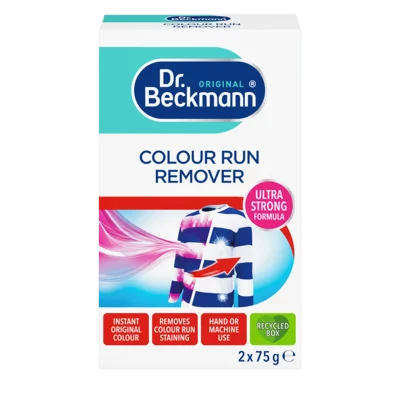
- Choose the right product: Home remedies may help with slight discolouration. For more noticeable colour transfer, we recommend using Dr. Beckmann Intensive Colour Run Remover, which specifically breaks down unwanted dye molecules.
Laundry Has Changed Colour: What to Do in Those Crucial First Few Minutes
It’s Sunday evening, the washing machine beeps, you open the door and realise with dismay that your laundry has changed colour. What should you do? The first and most important rule is: stay calm, but act quickly.
The biggest mistake you can make at this point is putting the affected laundry in the tumble dryer or hanging it up to dry. Once the fabrics dry, the unwanted dye molecules can become more firmly set in the fibres. If you want to remove the colour transfer successfully, it is therefore important to keep the fabric damp. Ideally, place the affected garment straight into a bucket of clean, cold water. This gives you a good starting point for rescuing laundry affected by colour transfer.
Next, check the care label on the affected items. The maximum temperature shown on the label will help determine the best next steps for removing the unwanted colour. Then separate the garment that caused the colour run from the rest of the laundry. Often, a single newly purchased T-shirt can be responsible for transferring colour to an entire load.
By separating it immediately, you can prevent further colour transfer and decide on the most suitable treatment, whether you want to restore discoloured white laundry or treat coloured and delicate fabrics as gently as possible.
Why Does Laundry Become Discoloured in the Washing Machine?
To understand how to remove unwanted colour from discoloured laundry, it helps to take a quick look at what causes the problem. Colour transfer occurs when unfixed dyes are released from one garment during the wash and are carried through the wash water onto other fabrics. The risk is particularly high with new garments that may still contain excess dye.
When caring for clothes and laundry, it is important to know that hot water causes the fibres to open up. This allows dyes to be released more easily, travel through the water in the drum and settle on light-coloured, absorbent fabrics. Fortunately, modern washing machines use significantly less water than they did twenty years ago, helping to conserve valuable resources. This is a major benefit for the environment. However, lower water levels also mean that dissolved dyes can be more concentrated in the wash water, potentially making colour transfer occur more quickly and intensely.
From four generations of research, we know that dye chemistry is complex. Not every stain is the same, and not every type of discolouration can be treated in the same way. While an ordinary stain often sits mainly on the surface of the fabric, unwanted dye released during washing can penetrate deep into the fibre structure. This is why regular laundry detergent alone may not be enough. To remove colour transfer effectively, you need a product specifically designed to break down unwanted dye and release it from the fabric.
Step by Step: How to Remove Colour Runs from Laundry
If you want to remove unwanted colour from your laundry, you can either treat the affected items in the washing machine or use the bucket method. The best option depends on how many garments are affected and how severe the discolouration is.
Method 1: Removing Colour Runs in the Washing Machine
This method is suitable when several items are affected and you want to treat the laundry with minimal effort.
Preparation: Place the damp, discoloured garments back into the washing machine drum.
Dosage: Add a specialist colour run remover, such as Dr. Beckmann Intensive Colour Run Remover, directly to the drum. For a normal load, you will generally need two sachets (approx. 150 g).
Choose the programme: Select a coloured or cotton wash programme, not a quick or eco programme. Set the machine to the highest temperature permitted by the garments’ care labels, ideally 60°C, as heat helps speed up the chemical process of removing unwanted dye.
Start the wash: Allow the programme to run its full cycle. Afterwards, run a regular wash cycle with your usual laundry detergent to remove any remaining residues.
Method 2: The Bucket Method for Stubborn Colour Runs
For individual garments or particularly severe discolouration, treating the laundry by hand in a bucket can often be more effective, as it gives you greater control over the soaking time.
Prepare the solution:Fill a clean bucket or tub with 6 litres of water that is as hot as possible, at least 60°C.
Add the colour run remover: Completely dissolve one sachet (approx. 75 g) of colour run remover in the water. Stir carefully.
Soak the garment:Fully immerse the garment, making sure it is completely covered by the solution.
Leave to soak:To remove the unwanted colour, leave the garment to soak for at least 4 hours. For severe discolouration, you can leave the textiles to soak overnight, for up to 24 hours.
Rinse:Afterwards, rinse the garment thoroughly with clean water and wash it in the washing machine as usual.
Colour-Run Scenarios: From Pink Laundry to Dull Greying
Every case of discolouration is different. Depending on the original colour and fabric, different approaches may be needed to successfully remove unwanted colour from your laundry.
Has Your White Laundry Changed Colour?
A typical scenario: your white laundry has turned pink because a red sock accidentally found its way into the washing machine. Red dyes can be particularly dominant and may bleed during washing. When washing white clothes, just one red item can be enough to turn an entire load pink.
If you want to restore discoloured laundry to white, you have the best chance with pure white cotton or linen fabrics. These can usually be treated with powerful colour run removers or even products containing bleaching agents, as there is no original base colour that needs to be preserved. Hot water, provided the care label allows it, can also help when removing unwanted colour.
Another common problem is white laundry turning blue. This often happens when new denim is washed together with light-coloured garments. If you are washing new jeans, bear in mind that indigo dye can bleed significantly during the first few washes. The same rule applies here: keep the affected laundry wet and treat it with a colour run remover as quickly as possible.
Removing Colour Runs from Coloured Laundry: Precision Is Key
Things become more challenging when coloured garments take on an unwanted shade. When treating colour runs on coloured laundry, the challenge is to remove only the transferred dye without affecting the garment’s original colour.
For this reason, you should always carry out a colourfastness test first. Dissolve half a teaspoon of colour run remover in a cup of warm water. Apply the solution to an inconspicuous area of the garment, such as the inside hem. Leave it to work for 15 minutes, then rinse thoroughly with clean water. Briefly dry the tested area with a hairdryer. If the original colour remains unchanged, you can proceed with treating the entire garment.
Home Remedies Put to the Test: Can They Remove Colour Runs from Laundry?
The internet is full of tips on how to rescue discoloured laundry using everyday items from the kitchen. But how effective are these home remedies really? Can baking soda and similar household products truly remove unwanted colour from laundry? The answer depends on the severity of the problem. Home remedies may help with very slight discolouration, but when it comes to more severe colour runs, they quickly reach their chemical limits.
Dishwasher tablets are often recommended for treating discoloured laundry. They contain bleaching agents and grease-dissolving enzymes. Add 4 to 5 tablets to 10 litres of hot water and leave the garment to soak overnight. This may help with slight greying on white cotton T-shirts. However, this method should never be used on delicate fabrics such as wool or silk, as the aggressive ingredients can damage the fibres.
Baking soda is a mild alkaline substance. Dissolve 4 tablespoons of baking soda in 5 litres of warm water and soak the clothes for several hours. Baking soda can be useful for removing unpleasant odours and reducing slight yellowing on white collars. However, it is generally not powerful enough to remove deep-set pink or blue colour transfer from laundry.
Vinegar is another commonly recommended home remedy. A splash of vinegar in 5 litres of water may help to fix colours in the fabric, making it more suitable as a preventative measure. However, when trying to remove existing colour transfer, vinegar can be counterproductive, as it may cause the unwanted dye to become more firmly set in the fabric. Citric acid has a mild bleaching effect but should only be used on robust white laundry.
Prevent Future Laundry Mishaps: How to Keep Your Clothes Colourfast
The best way to deal with colour transfer is, of course, to prevent it from happening in the first place. With a few simple habits in your laundry routine, you can save yourself the hassle of having to remove unwanted colour later.
Sort your laundry properly:Separating your laundry is one of the most important steps. Start by sorting it into dark, light/white and coloured loads. You can reduce the risk even further by separating red shades from blues and other colours.
Always wash new clothes separately:No matter how high-quality a garment is, newly dyed fabrics may release excess colour during their first few washes. Wash new coloured or dark garments separately for the first one or two washes, or together with similar colours that have already been washed several times.
Use Colour & Dirt Collector Sheets: One of the smartest ways to help prevent colour transfer in everyday washing is to use Colour & Dirt Collector Sheets. But how do colour catcher sheets work? The sheets are made from a special material designed to attract loose dyes released into the wash water. They capture and bind the dissolved dye before it can settle on other garments. Simply add a sheet to the drum when washing coloured laundry. This helps protect your clothes from unwanted colour transfer and reduces the risk of having to treat discoloured laundry afterwards.
Turn clothes inside out and adjust the temperature: Turn coloured garments inside out before washing. This helps protect the visible surface from friction and reduces mechanical stress on the outer fibres, helping to preserve the colour. For sustainability and colour protection, it is also advisable to use lower temperatures, such as 30°C, whenever your garments are only lightly soiled. Cooler water can help reduce the amount of dye released from fabrics.
Conclusion: The Easiest Way to Remove Colour Runs Is with the Right Product
A colour run in the washing machine is frustrating, but it does not necessarily mean that your favourite garment is ruined. The key is to keep the affected items wet and act quickly.
While home remedies may provide a quick solution for slight discolouration, a proven specialist colour run remover is the more reliable choice for severe colour transfer. Always check the fabric care instructions, choose the right treatment method, and even heavily discoloured laundry can often be successfully restored.
Frequently Asked Questions (FAQ)
Removing unwanted colour from purely synthetic fibres such as polyester, polyacrylic or polyamide can be extremely difficult or even impossible. With these materials, the colour pigments are often incorporated directly into the synthetic material during manufacturing. If these fibres subsequently become discoloured, the unwanted dyes can penetrate so deeply into the dense synthetic fabric that even powerful colour run removers may struggle to remove them.
White laundry can become discoloured when it is washed together with coloured garments that release dye into the wash water. Because white fibres have no colour of their own, transferred dye can be particularly noticeable on them. Even small amounts of loose dye in the washing machine can be enough to leave light-coloured fabrics looking dull or visibly discoloured.
A grey tinge can develop when limescale deposits or dirt particles build up in the fibres over repeated wash cycles, particularly when clothes are frequently washed at low temperatures. Washing white laundry occasionally at 60°C, provided the care label allows it, with a suitable heavy-duty detergent can help restore its brightness. Alternatively, specialist laundry whiteners or a suitable colour run remover may help bring back a brighter white appearance.
Yellow discolouration on white laundry, particularly around the underarms or collar, is often associated with a combination of perspiration, body oils and ingredients found in some deodorants. These marks may not respond to the same treatment used for colour runs.
Instead, pre-treat the affected areas before washing with a stain remover suitable for deodorant and perspiration stains. Allow it to work as directed, then wash the garment as usual.
Which Dr. Beckmann products help to solve the problem?
To remove unwanted discolouration, we recommend the following product: