How to Clean Your Dishwasher
Last updated:
You open your dishwasher and notice an unpleasant smell, or your dishes no longer come out as clean as expected. Over time, food residue, grease and limescale can build up in filters, spray arms, seals and other parts of the appliance. Regular cleaning helps prevent stubborn deposits and unpleasant odours while supporting good cleaning performance. How often your dishwasher needs cleaning depends on how frequently you use it, the level of soiling and the hardness of your water.
What matters when cleaning a dishwasher?
- Remove food residue and check the filter regularly to prevent build-up and unpleasant odours.
- Clean the dishwasher regularly, depending on how often you use it and how heavily it is soiled.
- Check the spray arms for deposits or blockages if cleaning performance decreases.
- Descale the appliance when needed, particularly in areas with hard water.
- Use only cleaning and descaling products suitable for dishwashers.
- Always follow your dishwasher manufacturer’s cleaning and maintenance recommendations.
How do dirt and limescale build up in the dishwasher?
During everyday use, food residue and grease can collect in the filter, spray arms, seals and other parts of the dishwasher. Minerals in hard water can also leave limescale deposits inside the appliance.
Over time, these deposits can contribute to unpleasant odours, blocked spray-arm nozzles and reduced cleaning performance. Regular cleaning, checking the filter and descaling when necessary help keep the dishwasher clean and well maintained.
Which products help to clean a dishwasher?
Different types of build-up may require different cleaning solutions. Grease, food residue and limescale can accumulate in different parts of the dishwasher, so regular cleaning and descaling when needed are important parts of appliance care.
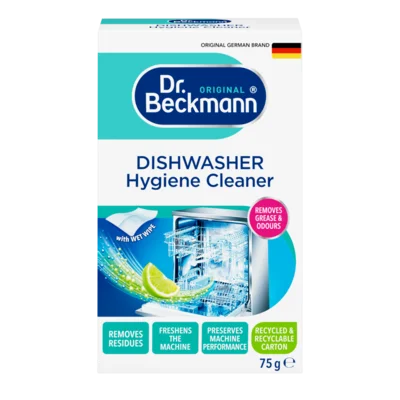
Discover the Dr. Beckmann dishwasher cleaning solutions available in your country below. Always follow the product instructions and your appliance manufacturer’s care recommendations.
Cleaning your dishwasher the right way
Food residue and grease can collect in the dishwasher filter over time. Remove the filter according to the appliance manufacturer’s instructions, rinse away loose residue and clean it carefully with warm water and a soft brush if necessary. Check that the filter is correctly reinstalled before using the dishwasher again.
If food particles or deposits block the spray-arm nozzles, water may not circulate effectively. Check the openings regularly and clean the spray arms according to your dishwasher manufacturer’s instructions. On some models, the spray arms can be removed for easier cleaning.
Grease and food residue can collect around the door edges and seals. Wipe these areas carefully with a soft, damp cloth and use only cleaning products suitable for the materials.
Regularly cleaning the interior can help remove grease, food residue and unpleasant odours. Depending on the level of soiling, use a dishwasher cleaner suitable for your appliance and follow the product instructions.
If you live in an area with hard water, limescale can build up inside the dishwasher. Use a suitable machine descaler when needed and follow both the descaler instructions and your appliance manufacturer’s recommendations.
How to help keep your dishwasher clean
Remove large food scraps before loading the dishwasher to help prevent them from collecting in the filter. Avoid overloading the dishwasher so that water can circulate properly, and always load the appliance according to the manufacturer’s recommendations.
If unpleasant odours or deposits appear, clean the affected parts and give the dishwasher a thorough clean as needed.
Can home remedies be used to clean a dishwasher?
Some household remedies are commonly used for light cleaning or odour removal, but they may not be suitable for every dishwasher or component. Acids in particular can affect certain materials and seals. Always check your appliance manufacturer’s care instructions before using a home remedy.
Bicarbonate of soda is sometimes used to help tackle light deposits and unpleasant odours. If permitted by your appliance manufacturer, use it carefully and avoid applying abrasive pastes to sensitive surfaces.
Citric acid is commonly used to tackle limescale, but concentration, temperature and material compatibility are important. If your dishwasher manufacturer permits its use, follow the instructions on the citric-acid product rather than using an improvised dosage.
Vinegar is also frequently recommended for limescale, but its acidity may affect seals and other sensitive materials. Only use it if permitted by your dishwasher manufacturer and follow the recommended method carefully.
For stubborn deposits or significant limescale build-up, a purpose-made dishwasher cleaner or machine descaler is usually the more targeted option.
Brief summary
Regular cleaning helps prevent food residue, grease, limescale and unpleasant odours from building up inside your dishwasher. Check the filter and spray arms regularly, clean the interior when needed and descale the appliance according to local water hardness and the manufacturer’s recommendations.
Selected household remedies may be useful for light cleaning if permitted by the appliance manufacturer. For stubborn deposits or limescale, purpose-made dishwasher cleaners and descalers are the more targeted choice.
Whatever cleaning method you choose, always follow the product instructions and your dishwasher manufacturer’s cleaning and maintenance recommendations.
FAQ: Cleaning dishwashers
Clean the dishwasher regularly depending on how often you use it, the level of soiling and the hardness of your water. Check the filter frequently for food residue and give the interior a more thorough clean whenever grease, deposits or unpleasant odours build up. Always follow the appliance manufacturer’s recommended cleaning intervals.
Remove the filter according to the manufacturer’s instructions and rinse away loose food residue under running water. If necessary, use a soft brush to remove stubborn deposits. Replace the filter correctly before using the dishwasher again.
Check the spray-arm openings for food particles or deposits that could restrict the water flow. Clean them carefully according to the appliance manufacturer’s instructions. Depending on the model, the spray arms may be removable.
Unpleasant odours can develop when food residue and grease collect in the filter, seals or other parts of the appliance. Clean the filter and interior thoroughly, check the spray arms and door area for deposits and use a suitable dishwasher cleaner if needed.
The need for descaling depends largely on local water hardness and how the dishwasher’s water-softening system is set up. If limescale deposits become visible or the manufacturer recommends regular descaling, use a product suitable for dishwashers and follow the appliance and product instructions.
Discover more appliance care solutions
Cleaning doesn’t stop at the dishwasher. Dr. Beckmann offers practical cleaning and care solutions for a range of household appliances. Discover more products to help keep your appliances clean and well cared for.